
Quick Facts Sacagawea Coin
| Feature | Details |
|---|---|
| Coin Name | Sacagawea Dollar |
| Country | United States |
| Value | $1 USD |
| First Issued | 2000 |
| Color | Golden (manganese-brass outer layer) |
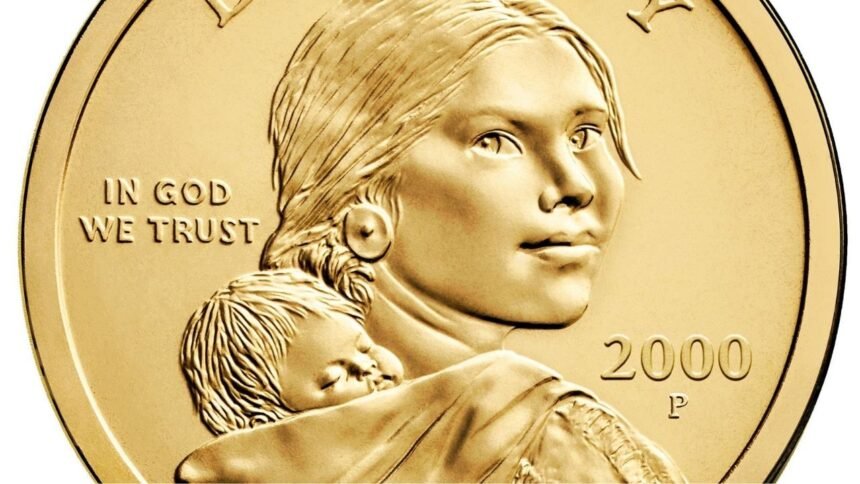
| Front Design | Sacagawea carrying her son, Jean Baptiste |
| Original Back Design | Soaring eagle surrounded by 17 stars |
The sacagawea coin is a U.S. dollar coin first minted in 2000, featuring the Shoshone guide Sacagawea on the obverse. Made of a golden manganese brass alloy, it carries a face value of $1 but certain rare versions—like the 2000-P Cheerios Dollar—can be worth thousands to collectors.
Few coins in U.S. history carry as much cultural weight as the Sacagawea dollar. Introduced to honor one of America’s most celebrated historical figures, the sacagawea coin blends numismatic artistry with a powerful story of exploration, resilience, and Native American heritage.
For collectors, the Sacagawea dollar offers a fascinating mix of history and potential value—especially when rare mint errors or limited editions are involved. For beginners, it’s an accessible entry point into sacagawea coincollecting, with most examples available for face value or just slightly above.
This guide covers everything you need to know: the sacagawea coin history, design features, specifications, rare varieties, current market values, and practical tips for collecting.
What Is the Sacagawea Coin?
The sacagawea coin is a U.S. dollar coin that has been produced by the U.S. Mint since 2000. It was created to replace the unpopular Susan B. Anthony dollar, which was frequently confused with a quarter due to its similar size and silver color.
The coin was designed to circulate widely as a modern, durable dollar sacagawea coin. Its distinctive golden color—achieved through a manganese brass clad composition—made it visually distinct from all other circulating U.S. coins at the time. While it never fully replaced the dollar bill in everyday transactions, it remains an important part of American coinage history.
Who Was Sacagawea?
Early Life
Sacagawea was born around 1788, a member of the Lemhi Shoshone tribe in present-day Idaho. At approximately 12 years old, she was captured by a rival tribe and later sold to or won by French-Canadian fur trader Toussaint Charbonneau, who made her one of his wives.
Role in the Lewis and Clark Expedition
Sacagawea’s most significant historical contribution came between 1804 and 1806, when she served as a guide and interpreter for the Lewis and Clark Expedition—the first American overland expedition to the Pacific Coast. She was just a teenager at the time and was pregnant when the journey began, giving birth to her son Jean Baptiste Charbonneau along the way.
Her knowledge of the land, languages, and local tribes proved invaluable. She helped the expedition navigate unfamiliar terrain, communicate with Native peoples, and secure horses for mountain crossings.
Historical Significance
Sacagawea has become a symbol of strength, courage, and the indispensable role of Native Americans in shaping U.S. history. She is one of the most memorialized women in American history, with statues, schools, and now a coin bearing her name.
History of the Sacagawea Dollar Coin
The U.S. Mint launched the Sacagawea dollar on January 27, 2000. The goal was to introduce a distinctive, easily recognizable dollar coin that would encourage public adoption. The Mint partnered with Walmart to distribute over 300 million coins before the official release date, giving the sacagawea coin significant early exposure.
The coin was originally called the “Golden Dollar” in marketing campaigns—a reference to its warm, golden hue rather than any gold content (the coin contains no gold).
In 2009, the reverse design began changing annually under the Native American $1 Coin Program, with each new reverse celebrating a different aspect of Native American history and culture. The obverse portrait of Sacagawea has remained consistent throughout.
Design Features of the Sacagawea Coin
Obverse Design
The obverse features a portrait of Sacagawea carrying her infant son, Jean Baptiste. The design was created by sculptor Glenna Goodacre, who used a Shoshone-Bannock woman named Randy’L He-dow Teton as her model—a decision that added authenticity to the depiction.
The inscription “LIBERTY” appears on the obverse, along with the year of mintage and the mint mark.
Reverse Design
The original reverse, used from 2000 to 2008, depicts a soaring bald eagle surrounded by 17 stars representing the 17 states in the Union at the time of the Lewis and Clark Expedition. This design was crafted by Thomas D. Rogers Sr.
From 2009 onward, the reverse designs change annually as part of the Native American $1 sacagawea coinProgram. Themes have included the Three Sisters agricultural tradition (2009), the Haudenosaunee Great Law of Peace (2010), and Wampanoag diplomacy (2011), among others.
Sacagawea Coin Specifications
| Feature | Detail |
|---|---|
| Face Value | $1.00 |
| Weight | 8.1 grams |
| Diameter | 26.5 mm |
| Thickness | 2.00 mm |
| Composition | 88.5% copper, 6% zinc, 3.5% manganese, 2% nickel |
| Edge | Plain (no reeding) with incused lettering |
The edge lettering includes the year of mintage, mint mark, and “E PLURIBUS UNUM,” a distinctive feature introduced in 2009.
Types of Sacagawea Coins
2000 Sacagawea Dollar: The original release, featuring the soaring eagle reverse. Produced in huge quantities—over 1.2 billion coins across the Philadelphia and Denver mints—most circulated examples are worth face value.
Native American Dollar Series (2009–present): Annual releases with rotating reverse designs honoring Native American contributions to U.S. history. Both Philadelphia (P) and Denver (D) mint versions are produced each year.
Proof Coins: Specially struck for collectors with highly polished dies, producing a mirror-like finish. Proof Sacagawea dollars are sold directly by the U.S. Mint, typically as part of annual proof sets.
Special Collector Editions: Enhanced uncirculated versions and burnished sacagawea coin have been issued at various points, offering slightly different finishes for dedicated collectors.
Rare and Valuable Sacagawea Coins
2000-P Cheerios Dollar
The most famous Sacagawea rarity. Early in 2000, General Mills included Sacagawea dollars in specially marked Cheerios boxes as part of a promotional campaign. Approximately 5,500 coins were distributed this way—and a small number feature enhanced, high-relief tail feathers on the eagle that differ from standard production coins. These “Cheerios Dollars” with the enhanced reverse can sell for $5,000 to $25,000 or more depending on condition.
Wounded Eagle Error
A die gouge on some 2000-P coins creates an irregular line running from the eagle’s breast toward its belly—giving the appearance of a wound. While not officially recognized as a major mint error, examples in high grades have sold for several hundred to a few thousand dollars.
Mule Error Coin
One of the most dramatic errors in U.S. coin history: a small number of coins were struck with a Sacagawea dollar reverse paired with a State Quarter obverse (specifically the 2000 New Hampshire quarter). Known as the “Sacagawea/State Quarter Mule,” only a handful are known to exist. One sold at auction for over $100,000.
Other Valuable Mint Errors
- Doubled die errors: Slight doubling of design elements under magnification
- Off-center strikes: Coins struck outside their normal centered position
- Clipped planchets: Coins where a portion of the metal blank was missing before striking
How Much Is a Sacagawea Coin Worth?
Most circulated Sacagawea dollars are worth exactly their face value—$1.00. Uncirculated examples in pristine condition typically sell for $1.25 to $3.00. The real collector value lies in rare varieties, proof versions, and mint errors.
Factors that affect value:
- Condition (grade)
- Mint mark (Philadelphia = P, Denver = D, San Francisco = S for proofs)
- Year of issue
- Presence of errors or special variety characteristics
- Certification by a major grading service (PCGS or NGC)
Sacagawea Coin Value Chart
| Year | Mint Mark | Average Value | Rare Value |
|---|---|---|---|
| 2000-P | P | $1–$3 | $5,000–$25,000 (Cheerios) |
| 2000-D | D | $1–$3 | $50–$150 (MS67+) |
| 2000-S | S (Proof) | $5–$15 | $50+ |
| 2001-P | P | $1–$2 | $20–$50 (MS67) |
| 2001-D | D | $1–$2 | $20–$50 (MS67) |
| 2009–Present | P/D | $1–$5 | Varies by design |
| Mule Error | P | N/A | $50,000–$100,000+ |
Values are approximate and subject to market fluctuation. Always consult a current price guide or certified dealer for accurate pricing.
How to Identify Rare Sacagawea Coins
Mint marks are located on the obverse above the date. “P” denotes Philadelphia, “D” denotes Denver, and “S” denotes San Francisco (proof only).
Error characteristics to look for include:
- Misaligned or doubled design elements
- Unusual surface marks or die gouges
- Mismatched obverse and reverse designs (the mule error)
- Off-center or partial strikes
Grading considerations: Coins are graded on a 70-point Sheldon scale. Coins graded MS65 or higher by PCGS or NGC command significant premiums over raw (ungraded) examples. For potential rarities, always invest in professional grading before buying or selling.
Where to Buy and Sell Sacagawea Coins
Coin dealers: Local and national coin dealers are reliable sources for buying and selling. Look for members of the American Numismatic Association (ANA) for added credibility.
Auctions: Major auction houses like Heritage Auctions and Stack’s Bowers regularly feature rare Sacagawea varieties. These are the best venues for selling high-value pieces.
Online marketplaces: eBay is the most active secondary market for sacagawea coin. Platforms like APMEX and JM Bullion also carry certified examples. Always verify seller feedback and request grading certificates for expensive purchases.
Tips for Coin Collectors
Storage methods: Store coins in acid-free holders, flips, or PCGS/NGC certified slabs. Avoid PVC-based plastics, which can cause chemical damage over time. Keep coins in a cool, dry environment away from humidity and direct sunlight.
Authentication tips: Purchase certified coins from PCGS or NGC whenever possible. Both services maintain online verification databases where you can confirm a coin’s certification number.
Avoiding counterfeit coins: Counterfeits of common Sacagawea dollars are rare given the low value, but fake “error” coins do circulate in the hobby. If a deal seems too good to be true, it almost certainly is. When in doubt, seek third-party authentication.
Frequently Asked Questions
Is a Sacagawea coin silver?
No. The Sacagawea dollar contains no silver. It is composed of a copper core with an outer layer of manganese brass (88.5% copper, 6% zinc, 3.5% manganese, 2% nickel).
Why is the Sacagawea coin gold colored?
The golden color comes from the manganese brass cladding used in its production. The U.S. Mint chose this composition specifically to distinguish the coin from smaller denominations and to mimic the appearance of gold without using the actual metal.
What is the rarest Sacagawea coin?
The rarest is widely considered to be the Sacagawea/State Quarter Mule Error, with fewer than 20 known examples. Among more widely available varieties, the 2000-P Cheerios Dollar with the enhanced eagle reverse is the most sought-after.
Are Sacagawea coins still being made?
Yes. The U.S. Mint continues to produce Sacagawea dollars under the Native American $1 Coin Program, with new reverse designs released annually. However, since 2012, these coins have been minted primarily for collector sets rather than general circulation.
Final Thoughts
The Sacagawea dollar is far more than a standard piece of pocket change. It represents a meaningful chapter in American history, a thoughtful redesign of the nation’s dollar coinage, and—for the right collector—a genuinely exciting numismatic pursuit.
For beginners, the best starting point is to pick up a few uncirculated examples from different years and explore the annual Native American reverse designs. For more experienced collectors, focusing on certified examples, known varieties like the Cheerios Dollar, and authenticated error coins offers both intellectual challenge and potential long-term value.
Whether you’re drawn to the history, the artistry, or the hunt for rare finds, the sacagawea coin rewards careful attention and patient collecting.