

Rental properties for passive income has long been a foundational pillar for building wealth. Tangible assets provide a sense of security that paper assets often lack. As economic conditions shift and inflation continues to influence living costs, everyday investors are looking for reliable ways to generate cash flow outside of their standard paychecks.
Earning money while you sleep is the ultimate financial goal for many people. However, the term “passive income” can sometimes be misleading when applied to real estate.
Managing physical buildings and dealing with human beings requires upfront work, strategic planning, and ongoing oversight. The “passive” element only materializes after you build solid systems, hire reliable property managers, and secure high-quality tenants.
What are rental properties for passive income?
A rental property is a real estate investment purchased specifically to generate revenue through leasing the space to tenants. Passive income from these properties is the net positive cash flow you keep after paying all expenses associated with the asset.
When you buy a home to live in, it acts as a liability that drains cash from your pocket every month. When you buy a rental property, it acts as a revenue-generating asset. The primary objective is to acquire a property where the monthly rent collected is significantly higher than the combined costs of the mortgage payment, property taxes, insurance, maintenance, and management fees.
This income stream is considered passive because, unlike a traditional job, you do not need to trade hours for dollars once the asset is operational. You can hire a property management company to handle daily operations, allowing you to scale your portfolio without dedicating 40 hours a week to landlord duties.
How does rental property income work in real life?
Theoretical real estate investing sounds simple. You buy a house, rent it out, and collect a check. Real-world application involves much more nuance and financial modeling.
Income generation operates on three distinct levels. The first is monthly cash flow. If your total monthly expenses equal $1,500 and your tenant pays $2,000 in rent, you generate $500 in pure monthly cash flow.
The second level is loan paydown, often called equity build-up. Every month your tenant pays the rent, a portion of that money goes toward paying down the principal balance of your mortgage. Over 15 to 30 years, your tenants completely pay off your debt, leaving you with a fully owned, high-value asset.
Why are rental properties a popular investment in 2026?
The financial landscape in 2026 presents unique opportunities and challenges that make rental properties for passive income highly attractive. Following the volatile interest rate fluctuations of recent years, rates have begun to stabilize, allowing investors to model their expenses with greater predictability.
Simultaneously, homeownership remains financially out of reach for a significant portion of the population. High property prices and strict lending requirements have created a massive pool of permanent and long-term renters. This high demand for quality rental housing ensures low vacancy rates for landlords who maintain their properties well and price them competitively.
What are the benefits of earning passive income from real estate?
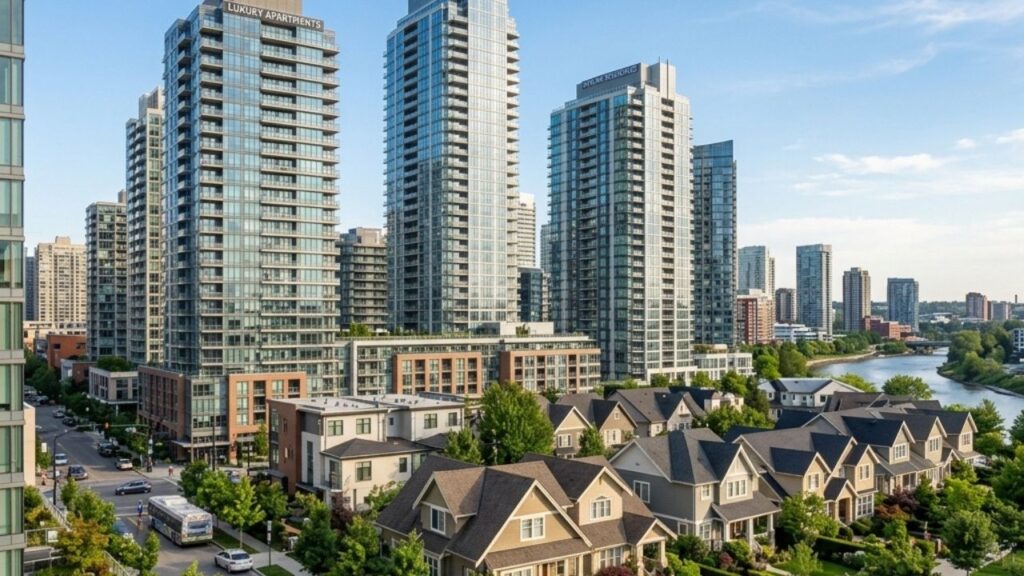
Real estate offers a combination of financial advantages that are difficult to replicate in the stock market or with other investment vehicles.
First, real estate provides powerful tax advantages. The IRS allows rental property owners to deduct operating expenses, property taxes, mortgage interest, and property management fees. More importantly, you can deduct depreciation. Depreciation is a paper loss that reduces your taxable income, meaning you can generate positive cash flow while legally reporting a loss to the government, minimizing your tax burden.
Second, real estate allows you to use leverage. You can purchase a $400,000 asset with only a $80,000 down payment (20%). If the property appreciates by 5%, the value increases by $20,000. That $20,000 represents a 25% return on your actual cash invested, significantly amplifying your wealth-building capacity.
Third, rental properties for passive income offer a hedge against inflation. When inflation rises, the cost of living increases. This allows landlords to raise rent prices to match market conditions. Meanwhile, if you hold a fixed-rate mortgage, your largest monthly expense (the loan payment) remains exactly the same. As rent goes up and your mortgage stays flat, your cash flow margins expand.
What types of rental properties can you invest in?
Choosing the right asset class dictates your daily involvement, your financing options, and your potential returns.
| Property Type | Definition | Best For | Pros | Cons |
|---|---|---|---|---|
| Single-Family Homes (SFH) | Standalone residential houses meant for one family. | Beginners seeking stable, long-term tenants. | Easy to finance, highly liquid, lower tenant turnover. | Vacancy means 100% loss of income for that month. |
| Multifamily (2-4 Units) | Duplexes, triplexes, or fourplexes. | Investors looking to scale faster or “house hack.” | One vacancy doesn’t stop all income; economies of scale. | More expensive upfront; higher tenant turnover. |
| Short-Term Rentals (STR) | Properties rented by the night or week (e.g., Airbnb). | Investors prioritizing maximum cash flow over stability. | Significantly higher revenue potential in tourist areas. | Requires intensive management; vulnerable to regulation changes. |
| Commercial Real Estate | Office spaces, retail storefronts, or warehouses. | Experienced investors with larger capital reserves. | Long leases (5-10 years); tenants handle most maintenance. | Difficult to finance; highly sensitive to economic downturns. |
Choose a single-family home if your priority is easy financing and low management intensity. Choose a short-term rental if your goal is maximizing monthly revenue and you are willing to operate the property like a hospitality business.
How much money do you need to start investing in real estate?
People often think that you have to be rich to buy investment properties.. The truth is, you do need some money and the amount of money you need depends on what you want to do and where you want to buy the investment properties.
If you want to buy a single family home with an investment loan the bank will usually want you to put down 20% to 25% of the price. So if you buy a house in the Midwest for $200,000 you will need $40,000 for the payment. You also have to think about the costs of closing the deal which’re usually 2% to 5% of the price of the house that is around $4,000 to $10,000..
Smart investors always make sure they have some extra money saved up about three to six months worth of expenses in case something breaks or the house is empty for a while. So in total you would need around $55,000 to buy the house safely.
But there is another way to do it it is called “house hacking”. This means you buy a house with units like a duplex and you use a loan for your main home, which usually only needs 3.5% to 5% down. You live in one part of the house. Rent out the other part.
If you buy a $200,000 house and put 5% down you only need $10,000 at first. The costs of closing the deal and some extra money saved up. Investment properties are still an option even if you do not have a lot of money you just have to be smart, about it and choose the right investment properties.
What is the step-by-step process to buy your first rental property?
Purchasing your first income property requires a systematic approach to avoid costly errors.
- Assess Your Finances: Review your credit score, calculate your debt-to-income ratio, and verify your liquid capital. Lenders want to see stable employment history and a credit score above 680 for the best investment loan rates.
- Get Pre-Approved for a Mortgage: Speak with a lender to understand your exact buying power. A pre-approval letter shows sellers you are a serious and capable buyer.
- Analyze Target Markets: Look for cities with strong job growth, increasing populations, and landlord-friendly laws. Avoid areas heavily dependent on a single industry.
- Build Your Real Estate Team: Connect with an investor-friendly real estate agent, a local property manager, and a reliable contractor. These professionals provide localized knowledge you cannot find online.
- Analyze Deals Daily: Run the numbers on multiple properties. Calculate the expected rent, subtract all expenses, and determine the cash flow. Submit offers only on properties that meet your strict financial criteria.
- Conduct Due Diligence: Once an offer is accepted, hire a professional home inspector. Check the roof, HVAC, foundation, and plumbing. If the property requires massive repairs, renegotiate the price or walk away.
- Close and Stabilize: Finalize the purchase, complete any necessary cosmetic renovations, and hand the property over to your management team for tenant placement.
How do you find good tenants and avoid property risks?
The quality of your tenant dictates the success of your investment. A great tenant pays on time, treats the property respectfully, and communicates maintenance issues promptly. A bad tenant can cost you thousands of dollars in eviction fees and property damage.
Avoid risks by setting clear boundaries in your lease agreement. Specify exactly who is responsible for lawn care, pest control, and minor repairs. Conduct bi-annual property inspections to ensure the home is being maintained properly. Most importantly, strictly enforce late fees. Training your tenants to respect the lease terms early prevents larger issues down the road.
What are the monthly expenses and hidden costs of rental properties?
New investors frequently underestimate the true cost of operating real estate. They calculate their mortgage, taxes, and insurance, but forget the hidden variables.
Always account for vacancy rates. Even the best rental properties for passive income sit empty between tenants. Budget 5% to 8% of your gross monthly rent for vacancy costs. Next, factor in maintenance and repairs. Roofs leak, water heaters break, and appliances fail. Allocate another 5% to 10% of gross rent into a repair fund.
Property management fees typically range from 8% to 12% of the collected rent, plus a placement fee (often equal to half a month’s rent) when securing a new tenant. Finally, consider capital expenditures (CapEx). These are large, long-term replacements like a new HVAC system or repaving a driveway. Failing to budget for CapEx will artificially inflate your monthly cash flow numbers, leaving you financially unprepared when a major system fails.
How do you calculate your rental yield and profit?
Accurate financial numbers are what separate professional investors from amateurs. Two key formulas help you figure out if an investment can be profitable:
- Gross Yield
- Cash-on-Cash Return.
Gross Rental Yield
This measures the income from a property compared to its purchase price.
The formula is:
( Rent / Purchase Price) x 100.
For example if a property costs $250,000 and generates $24,000 in rent per year
the Gross Yield is 9.6%.
Most investors want a yield of around 10% so they have money left for expenses.
Cash-on-Cash Return
This tells you how well your invested money is working.
The formula is:
(Annual Net Cash Flow / Total Cash Invested) x 100.
Lets say you invest $60,000 to buy a home.
After paying all the expenses you make $4,800 in profit per year.
So your Cash-, on-Cash Return is:
($4,800 / $60,000) x 100 = 8%.
What are the common mistakes beginners make in property investment?
Many beginners fail because they allow emotion to override mathematics. They buy a property because they like the kitchen cabinets, ignoring the fact that the neighborhood has high crime and stagnant job growth. Always let the data drive your purchasing decisions.
Another frequent mistake is underestimating repair costs. Beginners often look at a property needing a “minor cosmetic update” and budget $5,000, only to discover $20,000 worth of hidden plumbing issues behind the walls. Always pad your renovation budget by at least 15% to account for surprises.
Finally, novice investors frequently self-manage their properties to save the 10% management fee. Without experience, they fail to screen tenants properly, execute legally compliant leases, or address maintenance requests promptly. The money saved by self-managing is quickly lost during a prolonged vacancy or an expensive eviction process.
Is a rental property still a safe investment today?
Real estate is inherently safer than many speculative investments because it provides a basic human need: shelter. Regardless of technological shifts or stock market crashes, people will always require a place to live.
However, no investment is entirely risk-free. Local economic downturns, changes in zoning laws, and natural disasters can negatively impact property values. The key to mitigating these risks is diversification and thorough research. Investing in markets with diverse economic drivers (e.g., healthcare, education, and technology sectors combined) protects you if one specific industry experiences a recession. Buying adequate insurance protects your physical asset from catastrophic events.
Is passive income from rental properties right for you?
Building a portfolio of rental properties for passive income requires dedication, capital, and a willingness to solve complex problems. It is not a get-rich-quick scheme. It is a slow, calculated method for building generational wealth.
If you are prepared to analyze markets, build a trusted team of professionals, and delay immediate gratification for long-term financial security, real estate is an exceptional vehicle. Start by evaluating your personal finances, educating yourself on market analytics, and running the numbers on local rental properties for passive income today.
Frequently Asked Questions
Are rental properties actually passive?
Rental properties for passive income become passive only after you set up operational systems and hire a competent property management company. The acquisition, renovation, and team-building phases require active work.
How much cash flow is considered good for a single-family rental?
Most investors aim for a minimum of $200 to $300 in net positive cash flow per door, per month, after all expenses, reserves, and management fees are deducted.
Should I pay off my mortgage or buy another property?
Choose to buy another property if your goal is portfolio expansion and maximizing your returns through leverage. Choose to pay off your mortgage if your priority is absolute risk reduction and maximizing monthly cash flow on a single asset.
What is the 1% rule in real estate?
The 1% rule is a quick screening tool suggesting that a property’s monthly rent should equal at least 1% of its total purchase price. For example, a $200,000 house should rent for at least $2,000 per month to likely generate positive cash flow.
Can I manage my rental property from another state?
Yes. Managing out-of-state rental properties for passive income is highly common and easily executed by hiring a local, reputable property management company to handle tenant placement, rent collection, and maintenance dispatches on your behalf. Rental properties generate passive income by producing monthly rent that exceeds your mortgage, taxes, and operating expenses. Success in 2026 requires adapting to current interest rates, choosing the correct property type, accurately calculating cash-on-cash returns, and implementing strong tenant screening