
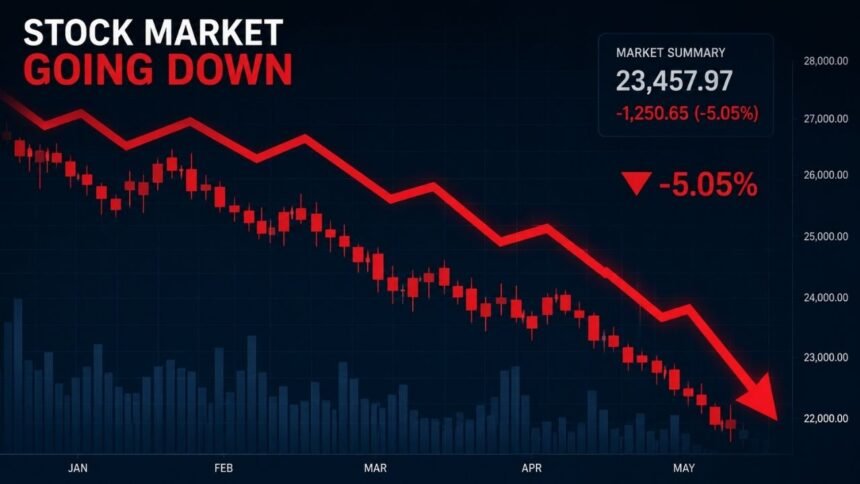
We’ve all been there – feeling stressed as our portfolio falls in value. Opening an app to see a plethora of red and watching the stock market going down can be stressful and make you wonder if you should sell all of your portfolio before things get worst for beginner investors.
Bear markets are far from catastrophic. In fact, they are a normal component of the oscillations that shape the trajectory of financial markets, which over time tend to head in an upward direction. There is certainly no need for the average person to fear a falling market, as long as they have an understanding of how these movements operate. In fact, for the savvy investor, every decline in the market can provide a wonderful opportunity.
Stock market downturns can be stressful and potentially destructive to one’s wealth. In this article we will provide you with some insight into why the stock market drops and go through some key points on what to do when the stock market is going down. Most importantly we will clarify the biggest mistakes that you should avoid and give you some practical advice on how to improve your investment technique in order to maximize your returns. By the end of this article you will be well on your way to having a concrete step by step plan to shield your hard earned assets and attain your investment objectives, even in the toughest of times.
Why is the Stock Market Going Down?
Before we start, it would be good to clarify why share prices fall in the first place. To answer this, we need to understand the underlying mechanics of the stock market, which is a giant Continuous Auction. This is an auction, or marketplace, where buyers and sellers trade “shares” in real time, and the price of the stock will fall when the number of sellers exceeds the number of buyers.
Why do people sell shares? Several factors may drive an investor to sell their shares.
Economic Changes
Economic health affects stock prices. High inflation affects the cost of living for everyone. Central banks battle high inflation by raising interest rates. Higher interest rates make it more expensive for businesses and consumers to borrow money which can result in lower corporate profits and lower stock prices.
Global Events
Uncertainty sucks for stock markets. That’s particularly true when the uncertainty is unpredictable and comes from somewhere outside of your normal market rhythms. Global events – whether they’re positive or negative – have a lot of power over the stock market. Because of this, even natural disasters, the threat of war, and global health issues can send stock markets plummeting. The root of this pain comes from the overall uncertainty of these kinds of events. They’re often unpredictable, and that can keep investors on edge for days or weeks at a time. And when people get uncertain, they tend to become risk averse, selling any investment with any amount of potential and moving to cash or other safer investments.
Normal Market Cycles
The market goes down for no apparent reason. Sometimes the market drops because the market has gone up too much. This may seem confusing since the market is down. Recall that stocks are “bullish” when they are moving up (because a bull charges forward) and “bearish” when they are moving down (because a bear crawls up a tree backward, and prices fall at least 20% from recent high levels). Cycles like these are typical, and much more typical than not.
A Step-by-Step Guide for Navigating a Market Drop

When the stock market goes down it is crucial that you have a strategy in place, and that you stick to it. See below for the 5 simple steps to safeguard your investments, avoid potential pitfalls, and ensure that your hard-earned money grows steadily.
Step 1: Stay Calm and Avoid Panic Selling
It’s tempting to try to stop your losses by selling your investments when they decline. But the reality is that by selling your investments when they are down, you will only serve to lock in your losses. By not selling, your losses are limited to the decline in value of your investment(s) in principle, but not in fact. And the record shows that, although severe, stock market declines from high points always reverse and recover over time.
Step 2: Review Your Financial Goals
Take a step back and look at your investment goals. Why are you saving for your retirement 20 years from now? What’s the five year goal that you’re trying to save up for? Is it a down payment on a house? If your goals are that far in the future, a market correction in the next few months is just a speed bump.
Step 3: Check Your Emergency Fund
Investing involves risk. A safety net is essential. Save three to six months of expenses in an easily accessible bank or credit union account. This fund will enable you to ride out a downturn in the market, should you happen to lose your job or require a surgeon, during a time when your investments may be dropping in value. Selling a depressed investment at a less-than-optimal time can be costly.
Step 4: Look for Buying Opportunities
The stock market can be thought of as a grocery store. Just as a drop in the price of your favourite items at the grocery store is a good time to stock up because their “sale” price is lower, a drop in the market presents an opportunity to purchase great companies at a lower price when the market is down. With a surplus of cash one can capitalise on this sell off and look to add solid performing stocks to one’s portfolio.
Step 5: Rebalance Your Portfolio
The mix of investments in your portfolio needs to be rebalanced over time. As stocks drop in value, the mix of your investments probably now consists of less stocks than you had intended. Automatic rebalancing means selling the investments that have done well (such as stocks) and buying the investments that have done poorly (such as bonds) thus forcing you to buy low and sell high.
Top Tips for Investing During a Downturn
Managing your finances can be far easier if you simply know how to follow a few successful financial strategies. Many of these same tips will be very valuable to investors who are worried about the markets falling.
Dollar Cost Averaging: Instead of fretting over timing the market and guessing that bottom dollar (which may or may not even exist), set up a schedule to invest fixed amounts of money at regular intervals – say every Friday – and let the market’s ebb and flow deliver greater value for your money over time. When market prices are high, your regular investment will acquire fewer shares, and when they’re low, your $100 will pick up more.
Spread Your Money: Don’t put all your eggs in one basket. Diversify your investment portfolio by including stocks across various industries such as technology, healthcare, retail, and consumer goods, etc., and also include large cap, mid cap and small cap stocks. If technology takes a tumble, other sectors could help cushion the loss.
Common Mistakes to Avoid When Shares Drop
Smart people make financial mistakes when scared. Don’t fall into the same pitfalls that the market downturn has for the savvy investor.
Checking Your Portfolio Every Day
There is very little more stressful than watching your hard-earned savings get carved out of your account month after month and decreasing in value as the years tick by. That pain vanishes, however, when you remind yourself that the fluctuations of the markets are noise for the long-term stock market going down investor. Consider deactivating the investing app on your phone to cut off the constant urge to check the markets. Log in every month (or quarter) to check performance and to deposit new funds, but no more than that.
Trying to Time the Market
Most new investors make the mistake of selling out of their stocks at the worst time, hoping to purchase them back at a lower price. In reality, you have to be right twice. You have to be right when you sell your shares at a high price, and you have to be right when you repurchase them at a lower price. Honestly, even the most seasoned and intelligent of investors struggle with this.
Stopping Your Regular Contributions
Part of building wealth is learning to tune out the nonstop stream of negative media regarding the stock market going down. What makes this even more tempting is to stop saving and investing for retirement. And by stopping contributions to your retirement account, or even simply ceasing to automatically transfer money to your brokerage account, you are ensuring that you will never buy stock at its lower price. Keep the money flowing, even when the news is bad.
How to Improve Your Investment Strategy for the Future
| Day | Stock Price | Market Trend |
|---|---|---|
| Mon | 100 | 📈 Up |
| Tue | 95 | 📉 Down |
| Wed | 98 | 📈 Recovery |
| Thu | 92 | 📉 Drop |
| Fri | 97 | 📈 Rise |
Every bear market is an opportunity for investors to learn and become better in the long run.
Build Emotional Resilience
How did you feel when markets were dropping recently? Sleepless nights? Anxiety? Stress? If your current portfolio investment approach is causing you this kind of distress, your portfolio may be too aggressive. Introducing more stable, less volatile instruments such as bonds or index funds could ease the pain of future declines.
Keep Learning
Financial education is one of the best protections from the fear that can affect the market and your returns. I encourage readers to dive into books written from the perspective of successful investors, including those from Warren Buffett and Stock Market Going Down Bogle. There is no shortage of insight into the markets and investing generally that can help calm the nerves and help investors see through volatile price activity.
Staying the Course When Stocks Drop
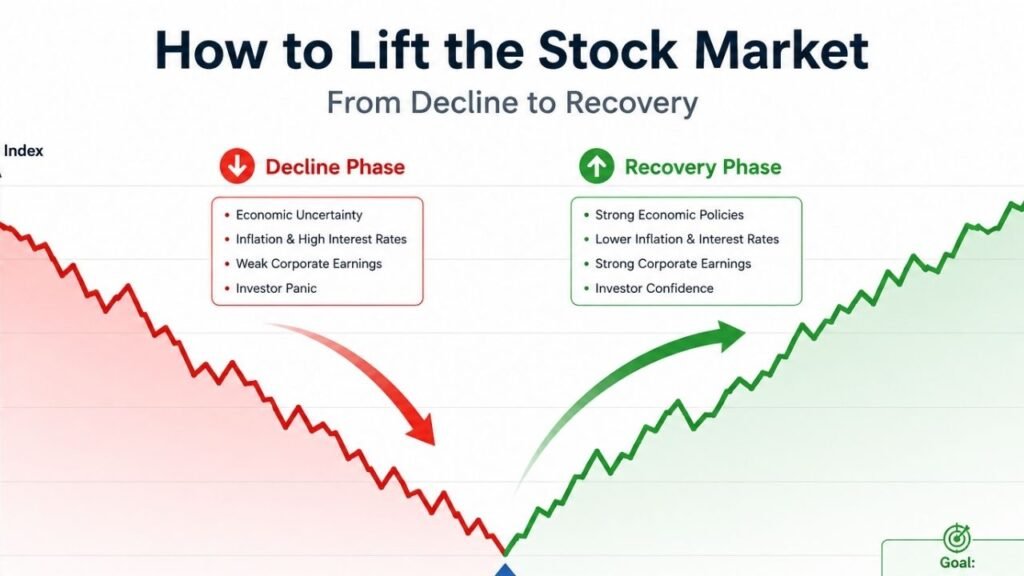
Watching your stock portfolio decline in value is never pleasant. However, decline is an inevitable part of investing. Periods of sharp growth are usually followed by a correction in the markets.
Most successful investors are not geniuses who can accurately forecast the future and rack up massive gains by betting on the market. They are, instead, smart enough to devise an investment plan and then stick to it, consistently suppressing emotions and avoiding the trap of both excessive enthusiasm and fear. Fortunately, achieving successful investing outcomes is well within reach of the average individual. By establishing an easily accessible cash reserve, inverting and averaging the cost of investments over time, and resisting the impulse to sell a securities portfolio after its value drops, an investor can blunt expected returns on the way down while Stock Market Going Down a healthy ability to capitalize on returns on the way up. In the long run, letting time and markets handle the hard work is more often than not the best strategy.
Frequently Asked Questions (FAQs)
Is it normal for the stock market to go down?
Is it that unusual? No! Stock markets go up and down every day. Major drops of 10% or more happen on average every 1 to 2 years. These significant price corrections are a normal and even healthy part of the investment world.
Should I pull my money out when the market drops?
No. Because withdrawal of investment during a downturn turns the temporary loss of money into a lifelong loss. Unless there are some special reasons, such as fund requirements for urgent needs, etc., it is wiser to stick to the investment and allow it to grow once the market recovers.
What is a bear market?
A bear Stock Market Going Down when the stock market drops by 20% or more. The term bear market is typically associated with negative investor sentiment and a general pessimistic feeling throughout the market. Like any downturn, bear markets are temporary.
How long does a Stock Market Going Down last?
There is no specific time frame for a bear market; it can be short or long, but one thing you can count on is that bull markets (growth markets) historically last a lot longer than bear markets.