
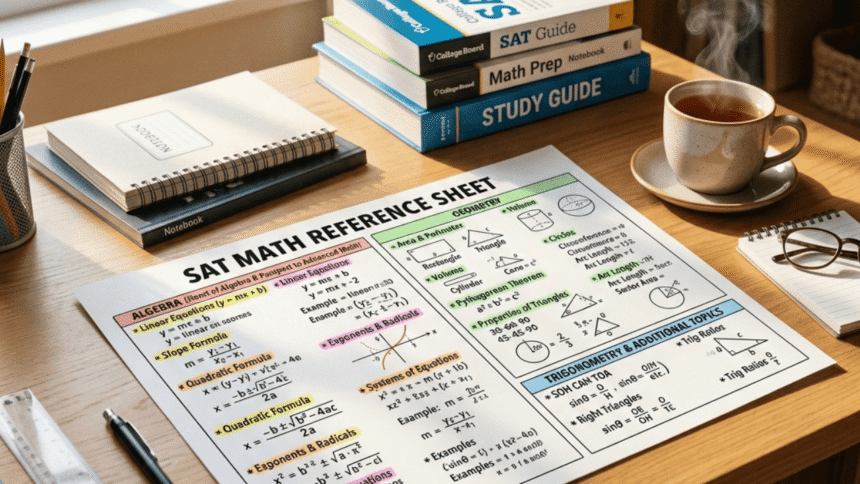
Taking the sat reference sheet can feel like a daunting challenge, especially when you reach the math section. For many students, the pressure to memorize dozens of complex mathematical equations adds an unnecessary layer of stress to test day. You might find yourself staring at a blank wall, desperately trying to remember the volume of a sphere or the side ratios of a special right triangle.
Fortunately, the College Board provides a built-in safety net. At the beginning of every math section, test-takers are given a built-in guide containing several vital mathematical formulas and facts. This tool is designed to ease the burden of rote memorization, allowing you to focus on problem-solving and critical thinking instead.
However, simply having access to these formulas does not guarantee a high score. Many students make the mistake of relying too heavily on this cheat sheet, wasting precious time searching for equations during the exam. Others ignore it entirely and end up missing straightforward geometry points because they misremembered a basic rule. To truly excel, you need a solid strategy.
Understanding exactly what is—and what is not—included on this document is crucial for your test prep. By integrating this tool into your study routine, you can maximize your efficiency and confidence. This guide will walk you through everything you need to know about the SAT reference sheet, from the specific formulas included to the best strategies for using them effectively.
What Is an SAT Reference Sheet?
An SAT reference sheet is a brief collection of mathematical formulas and geometric rules provided to all students taking the SAT. You will find it located at the very beginning of the Math section. In the digital SAT format, it is easily accessible via a clickable icon on your testing screen.
The primary purpose of this sheet is to provide standard geometric formulas. The test creators want to assess your ability to apply mathematical concepts to complex problems, rather than your ability to memorize standard geometric properties. Therefore, the sheet gives you the foundational tools required to solve area, volume, and right-triangle problems.
Important Formulas Included in an SAT Reference Sheet
The reference sheet is highly specific and primarily focused on geometry. It includes visual diagrams and corresponding formulas for various two-dimensional and three-dimensional shapes.
First, you will see formulas for finding the area of two-dimensional shapes, specifically circles, rectangles, and triangles. You will also find the formula for the circumference of a circle.
Next, the sheet provides the Pythagorean theorem, which is essential for finding the missing side length of a right triangle. Alongside this, you will find the specific side-length ratios for two special right triangles: the 45-45-90 triangle and the 30-60-90 triangle.
Finally, the document lists several volume formulas for three-dimensional solids. These include rectangular prisms, cylinders, spheres, cones, and rectangular pyramids. At the very bottom, the sheet also reminds you that the number of degrees in a circle is 360, the number of radians in a circle is 2π, and the sum of the interior angles of a triangle is 180 degrees.
How to Use an SAT Reference Sheet Effectively
Having the answers in front of you only helps if you know when and how to apply them. The most effective way to use the SAT reference sheet is as a backup verification tool, rather than a primary resource.
During the test, time is your most valuable asset. If you have to pause, open the reference tool, locate a formula, and figure out how to plug in the numbers for every geometry question, you will run out of time. Top-scoring students memorize the formulas on the sheet before test day.
You should use the reference sheet to double-check your memory if you experience a moment of panic. If you are 90% sure about the formula for the volume of a cone but want to be absolutely certain before doing the calculation, a quick glance at the sheet will give you the confidence to proceed.
SAT Math Reference Sheet for Beginners
If you are just starting your SAT preparation journey, the math reference sheet is a great place to begin familiarizing yourself with the test’s content. Print out a copy of the official sheet and keep it next to you while you complete your initial practice problem sets.
As a beginner, use the sheet actively. Whenever you encounter a geometry question, try to solve it from memory first. If you get stuck, look at the sheet to identify which formula applies to the problem. Over time, make a note of which formulas you have to look up most frequently. These are the areas where you need to focus your memorization efforts.
Eventually, you want to wean yourself off the physical sheet. By your third or fourth full-length practice test, you should aim to complete the math section without ever needing to look at the provided formulas.
Essential Algebra Formulas for the SAT
One of the most critical things to understand about the SAT reference sheet is what it excludes. The sheet provides zero algebra formulas. Since algebra makes up a massive portion of the SAT Math section—particularly through the “Heart of Algebra” and “Passport to Advanced Math” question types—you must memorize these on your own.
You need to know the quadratic formula by heart. You also need to understand the slope-intercept form (y = mx + b), the point-slope form, and the standard form of a linear equation. Furthermore, you must be comfortable with the vertex form of a parabola to quickly identify the minimum or maximum values of a quadratic function.
Failing to memorize these algebraic rules will severely limit your scoring potential. Create flashcards for these concepts early in your study schedule.
Geometry Formulas You Need for the SAT
While the reference sheet covers the basics of geometry, there are a few additional geometric concepts you should memorize to increase your speed and accuracy.
For instance, while the sheet gives you the formula for the area of a circle, it does not explicitly give you the formula for the area of a sector, or the arc length of a circle. You will need to know how to set up a proportion using the central angle to solve these types of questions.
Additionally, knowing the equation of a circle in the coordinate plane is completely mandatory. You will likely see at least one question asking you to identify the center or radius of a circle based on its algebraic equation. The reference sheet will not help you there.
SAT Trigonometry Reference Sheet Explained
Trigonometry on the SAT is relatively basic, and the reference sheet reflects this by keeping things simple. The sheet does not explicitly spell out the trigonometric ratios (sine, cosine, and tangent). You must memorize the acronym SOH CAH TOA on your own.
However, the sheet does provide the conversion factor between degrees and radians (360 degrees = 2π radians). This is immensely helpful when you encounter a question asking you to convert an angle measure.
The special right triangles provided on the sheet also tie directly into trigonometry. Understanding the ratios of 30-60-90 and 45-45-90 triangles will allow you to quickly evaluate the sine, cosine, or tangent of these common angles without needing a calculator.
Best Printable SAT Reference Sheet PDF
To practice effectively, you need to use the exact same materials you will see on test day. Do not rely on third-party study guides that might format the information differently.
The best printable SAT reference sheet PDF is the one provided directly by the College Board. You can find this by downloading any of the official, free full-length linear practice tests available on the College Board website. Scroll to the beginning of the math section, and print that specific page. Pin it to your bulletin board, keep it in your math notebook, and use it as your gold standard for practice.
Common SAT Formula Mistakes to Avoid
Even with the formulas provided, students frequently make preventable errors. One of the most common mistakes is mixing up the radius and the diameter. The formulas for the area and circumference of a circle use the radius (r). If a problem gives you the diameter, you must remember to divide it in half before plugging it into the equation.
Another frequent trap involves the volume formulas. Students often forget to apply the 1/3 fraction when calculating the volume of a cone or a pyramid, confusing them with cylinders or prisms. Always double-check the formula on the reference sheet if you are dealing with a shape that tapers to a point.
Finally, students often misapply the special right triangle ratios. Make sure you align the correct side ratio with the correct angle. The side opposite the 30-degree angle is always the shortest side (x), while the side opposite the 60-degree angle is x√3.
Tips to Score Higher Using an SAT Reference Sheet
Your primary goal should be to build your mathematical fluency so that the reference sheet becomes an afterthought. Here are a few ways to achieve that:
Review the sheet thoroughly before the test. You should know exactly where each formula is located on the page so you can find it instantly if necessary.
Use the special right triangles to save time. If you see a square with a diagonal drawn through it, immediately recognize that you have two 45-45-90 triangles. You can use the provided side ratios to find the diagonal length without having to grind through the Pythagorean theorem.
Recognize that the presence of the sheet means the test makers are testing your application skills, not your memory. If a problem seems like it requires an impossibly long calculation, you are probably missing a simpler geometric relationship that the reference sheet could help clarify.
Frequently Asked Questions About SAT Reference Sheets
Is the reference sheet available on the digital SAT?
Yes. On the digital SAT, the math reference sheet is available as a pop-out window. You can access it at any time during the math section by clicking the “Reference” icon at the top of your testing application.
Are there any algebra formulas on the SAT reference sheet?
No. The provided sheet focuses almost exclusively on geometry. You are responsible for memorizing all necessary algebra formulas, including the quadratic formula, slope formulas, and exponent rules.
Does the SAT provide a calculator reference sheet?
No. The SAT provides a built-in graphing calculator (Desmos) for the digital test, but there is no reference sheet detailing how to use it. You must practice with the Desmos calculator before test day to learn its functions and shortcuts.
Take Control of Your SAT Math Prep
The SAT reference sheet is a helpful tool, but it is no substitute for rigorous preparation and mathematical fluency. By understanding exactly what is on the sheet, recognizing what is missing, and practicing until the core formulas are second nature, you can navigate the math section with speed and precision.
Start taking full-length practice tests today. Make flashcards for the vital algebra rules, memorize those special right triangles, and use the official reference sheet to build your confidence. With the right strategy, you can turn the math section into your highest-scoring area.