
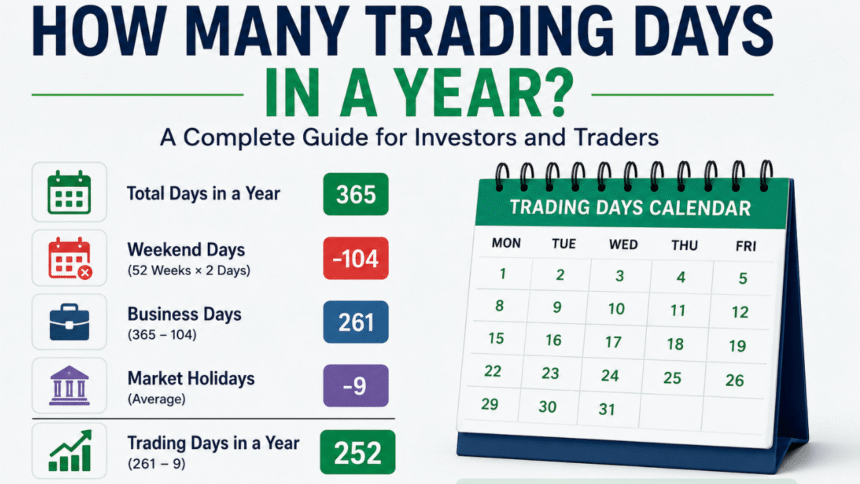
How many trading days in a year is one of the most common questions among beginner investors. Many people assume the stock market operates every single day throughout the year. However, stock exchanges remain closed during weekends and several public holidays. Understanding the number of trading days helps investors plan strategies, calculate returns, and manage investments more effectively.
Being aware of the actual number of trading days in the year can be crucial for effective financial planning. All traders need to calculate their potential return on investment for the year, and stock market data systems need to know the correct number of trading days to calculate historical price movement. Your portfolio management skills will improve with just this piece of information. So, what is the standard stock market year and what is the exact math behind it?
Understanding the Basic Market Math
In an ordinary calendar year, there are 365 days, sometimes 366. The stock market however operates only on business days, weekdays, during the year. We would therefore have to subtract the number of weekend days. A regular calendar year has 12 months, thus it has 52 weeks. Excluding these weekends from our sampling period means we have to exclude 104 weekend days.
After removing the weekends from the year we have 261 business days. This is the absolute maximum number of possible business days that could be active in the stock market in a given year. However, the stock market also observes several major public holidays throughout the year, which will reduce the final count of active business days even more.
United States Stock Market Holidays
The US stock market typically closes for nine Federal Holidays each year. In addition to the better known New Year’s Day and Martin Luther King Jr. Day, the market is also closed for Presidents’ Day and Good Friday. During the summer, Memorial Day and Independence Day are observed. In the fall, the stock market is closed for Labor Day, Thanksgiving Day and Christmas Day. However, some banks may remain open on these days. Other observed holidays, such as Easter Sunday, may have irregular trading hours.
If we subtract the nine holidays from those 261 business days, the total number of days decreases again. 261 business days minus 9 holidays equals 252 trading days. Therefore, a standard year has 252 trading days. This number is critical to financial professionals to ensure accurate yearly calculations.
How Leap Years Affect the Schedule
A leap year is a year in which the calendar has an extra day. Every four years, the calendar is updated to include an extra day to keep it aligned with the Earth’s orbit. This extra day is added to February, making 29 days in the month instead of the typical 28. The extra day in a leap year typically falls on a Friday, but can occur on a Monday, Tuesday, Wednesday or Thursday. As a result, the number of trading days in the year increases by one, resulting in 253 trading days as opposed to the typical 252.
But that extra day doesn’t necessarily mean there’ll be an extra trading session. Depending on the regular closure days set by the market, that extra day will fall on a weekend. Investors should check specific calendars for leap years to better understand implications. For most financial models, however, two hundred and fifty-two trading days are used to avoid introducing errors in models that rely on historical data over long periods of time.

Why the Number of Trading Days Matters
So, how many trading days are in a year? If you’re a day trader, this is the number of days you have available to actually trade. Investors and long-term holders of stocks, however, calculate their annualized return on investment using this same number. And, as you probably noticed, most business software programs use a standard number of trading days in a year when generating these forecasting charts. So, everyday financial analysts are using this number in their work.
Many readers will not realise that your own investment expectations can be better managed by breaking down any investment goal you have into an easily manageable number of days. For example, if you have a target of earning $10,000 per annum then you simply divide this by 252 to get a daily target of $40 per day. Breaking down a large goal into an easily manageable daily number will assist in reducing emotional pressure when share trading.
Calculating Annual Volatility
Volatility refers to the amount to which the share price of an investment falls and rises. Although volatility is often discussed in terms of percentage movements over a longer period, volatility is formally measured by the number of trading days. For mathematical calculations, it is therefore usual to assume a year has 252 trading days. This means that a stock with 20% annual volatility will have on average a daily movement of around 0.16%. Volatility measurement enables investors to compare the risk of different investments.
Volatility in markets is a fundamental measure that investors use when deciding on stock portfolios. A stock trading with high volatility on any given day is riskier than one with low volatility. It is therefore very important to accurately measure the volatility of any stock. One key aspect to this calculation is the number of market days or trading sessions, which is why the stock market calendar is such an important tool for everyone.
Global Stock Market Schedules
The 252 day rule is mostly applicable in the United States. The stock markets of other countries have completely different calendars of national holidays. The London Stock Exchange, for example, observes different public holidays than Wall Street. Asian markets, such as the Tokyo Stock Exchange, also have their own national holidays to observe. This can make for quite an interesting schedule for international investors who are tracking markets all around the world.
If you trade global stocks then it is important to have a good understanding of the various countries that make up your investment portfolio. While in the United States today may be the 4th of July, a federal holiday for Americans it is just another business day in other countries around the world. As an active trader of global company stocks you can take advantage of these circumstances to buy stocks of European or Asian companies when American markets are normally closed.
European Market Differences
European markets, such as London Stock Exchange and Euronext, traditionally observe several national holidays, including Easter Monday and Boxing Day. How many trading days in a year these two holidays are not observed by US markets. As a result, the total number of trading days for markets such as Frankfurt, Paris, Zurich and Amsterdam may be a few more than those trading in the United States. Importantly, investors who purchase European securities will need to update their software calendars to reflect these differences. Without this change, they risk experiencing unexpected delays as they attempt to execute their trades.
Final Thoughts
So, how many trading days are in a year? In most cases, the stock market operates for approximately 252 trading days annually. This number helps investors calculate returns, monitor volatility, and build realistic financial goals. Understanding the stock market calendar can also improve long-term investment planning. Every investor should know this basic market concept before entering the trading world.